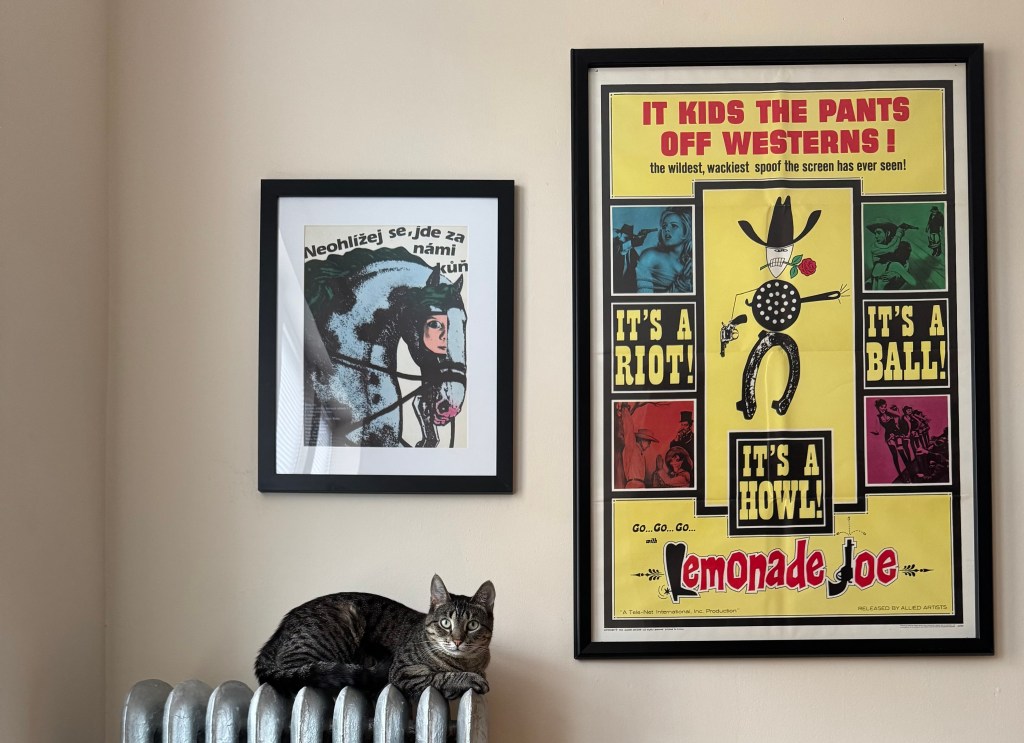
Kočka Perla likes having company while she eats. I was up way past my bedtime after midnight sitting with her, scrolling through Deaf Crocodile’s member Discord server. The boutique Blu-ray company had been sharing sneak peeks of their new title announcements for the rest of the year before posting them on their public social media. I was really happy to see the announcement that they would release the classic 1964 Wild West musical comedy Limonádový Joe aneb koňská opera (LEMONADE JOE OR HORSE OPERA). However, they said something about it being called SODA POP JOE now. It was strange and sounded like a joke. As I scrolled through the feed to learn more, I saw the next title announcement was my favorite Czechoslovak director Juraj Herz’s film Pasáž (PASSAGE)! I was shocked and so excited by the news! It’s a very cool movie, but I don’t think it’s even had a DVD release. I have a really smudgy looking file, which looks like a tape of a tape that sat in someone’s hot attic for years. Even though the file looked terrible, I still loved the movie. If you’ve ever wandered around any of Prague’s passages and worried about getting lost, Pasáž is the nightmare version of that scenario come to life. I was kicking myself for checking Discord right before going to bed, because I was so excited about Pasáž getting a fancy Blu-ray release that I couldn’t sleep.
Kočka Perla also likes waking us up around 5:45am, so as I went about my morning routine feeling sleep-deprived, it suddenly popped in my head, “wait…what was that about SODA POP JOE?!” I read the announcement again, “By order of the Národní filmový archív, it’s called SODA POP JOE now”. I checked the Národní filmový archív (National Film Archive) page for Limonádový Joe, and sure enough, it listed the English title as SODA POP JOE. My immediate reaction was that this was heresy! Who does the Národní filmový archív think they are?! The movie has been known in English as LEMONADE JOE for 60 years! I found myself having a minor existential crisis whilst trying to get ready for work.
If you’ve ever learned another language, you are familiar with the concept of “false friends.” The word limonáda sounds like lemonade, but it isn’t lemonade. It is used as a general term for soft drinks. Lemonade is a limonáda, but not all limonády are lemonade. As a tourist in Czech Republic, I’m mostly eating at cafes, restaurants, and food stands. The menu will say napoje for drinks, and often they will offer domácí limonáda. This is usually lemonade, but it’s not like the syrupy-sweet Country Time Lemonade that you get in the US. It’s real lemon juice, sugar, and water. It is not always just lemon, though. It may be lemon with lime, cucumber, basil, mint, other fruits, and it may not have any lemon in it at all. If a cafe or restaurant offers different flavors of domácí limonáda, they will specify the main fruit, i.e. malinová (raspberry), grepová (grapefruit), atd. In that case, lemon-flavored lemonade is designated as citronová limonáda. After all, the Czech word for lemon isn’t limon, it is citron! In that context, and because it’s a false friend, I’ve always thought of limonáda as lemonade. Different than American lemonade, but still that basic concept of fruit juice, sugar and water.
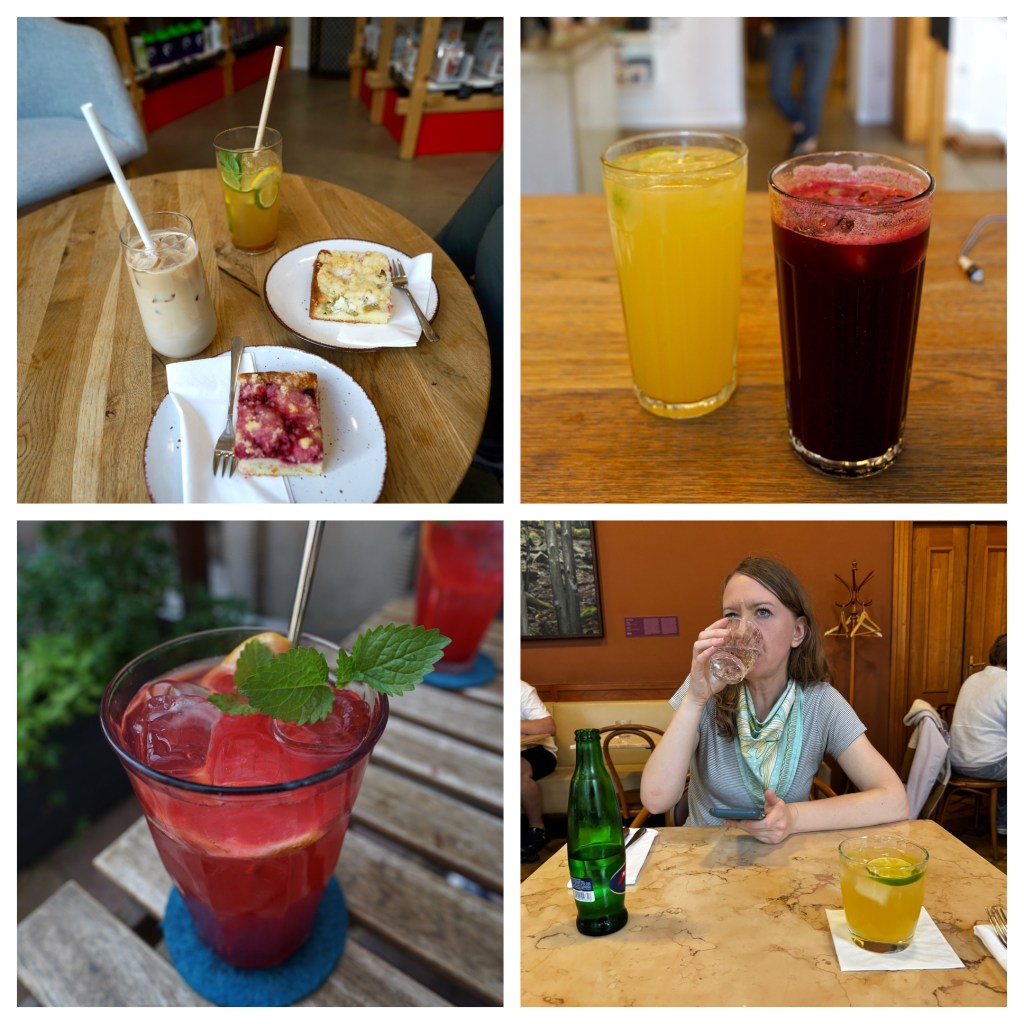
I asked my Czech teacher Kristýna about how napoje and limonáda are used. Napoje can be any drink, which is why it is the term used most often on menus: alcoholic or non-alcoholic, hot or cold, sparkling or still. Limonáda is used for non-alchoholic cold drinks. So beer, wine, coffee, and tea are not limonády, but Coca-Cola, Kofola1, fruit sodas, lemonade, ginger beer, kombucha, and seltzer/tonic water are. If an American is drinking a beer with low alcohol content, they might say it’s like drinking water or swill; Czechs will say it’s like limonáda.
The word limonáda comes from the French word limon2 (though the French word for lemon is also citron). Limonáda has been the Czech word used for soft drinks of any fruit or flavor since the 1950s. There are regional differences, though; in Moravia, they are more likely to say sodovka (soda) and Slovaks say malinovka (raspberry).3
In the film Limonádový Joe, our titular hero is a gunslinger who touts morality and temperance as the reason for his incredible skill with a pistol. It is also a sales tactic for his beloved drink, called Kolaloka. The noun lok means a drink or sip, so kola loka is “a sip of cola” (loka being the genitive form of lok).4 What type of drink is Kolaloka, though? The bottles in the movie have a big label on them, and the movie is black and white with color tints, so it’s difficult to see what the liquid inside looks like. Cola drinks are usually translucent brown, and lemonade is usually hazy yellow, but Kolaloka is clear. It also appears to be still, not sparkling. Soda pop can be many colors, but one thing it must be is sparkling. The Kolaloka bottles look like they are filled with still water.
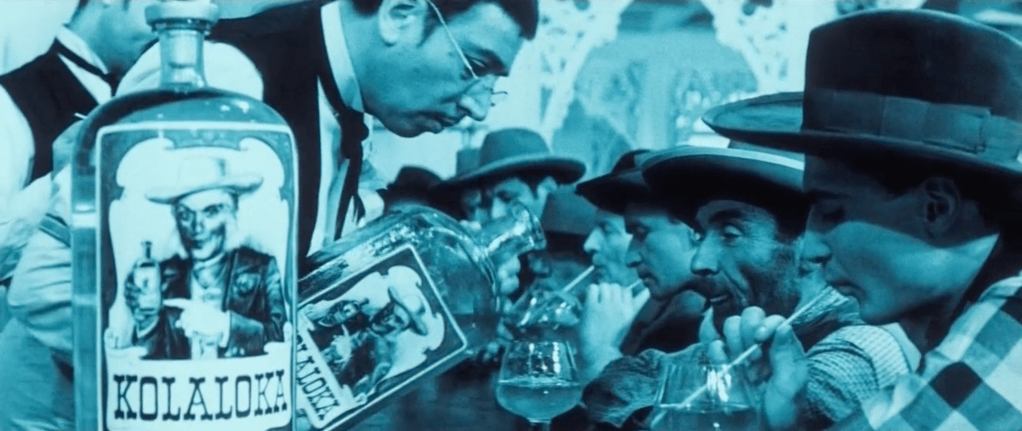
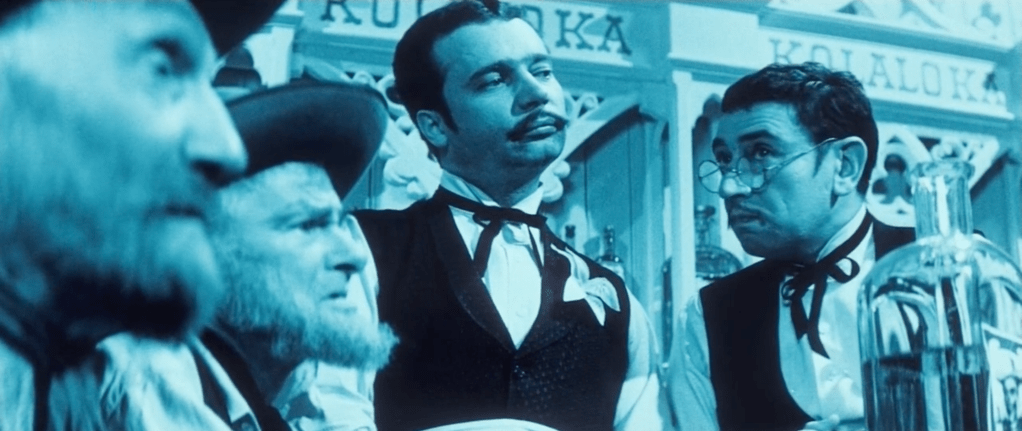
Limonádový Joe is set in 1885, which is also the year that Pemberton’s French Wine Coca nerve tonic in Georgia, USA and Kola Coca in Spain were both invented. Pemberton created Coca-Cola as a non-alcoholic version of his tonic in 1886 after local prohibition legislation passed [Coca-Cola bought Kola Coca in 1953]. Carbonated water was considered good for your health, and Coca-Cola was sold as a cure for diseases such as morphine addiction, indigestion, nerve disorders, headaches, and impotence.5 Kolaloka is similarly touted as a cure for all that ails, even death!
On the other hand, lemonade has been around for much longer, since at least the 12th century. Carbonated lemonade came in 1833.6 The first major carbonated lemonade company, R. White’s in London in 1845, sold a wide variety of soft drinks. From the early photos I could find online, they seemed marketed as refreshments rather than as medicines or products for good health.7
The film Limonádový Joe aneb koňská opera was co-written by the prolific screenwriter, dramaturg, and animated film director Jiří Brdečka. He loved to read, and he loved history. He could read in French, German, and English.8 Brdečka also loved American films, which were easy to see before the US entered World War II, but he especially loved Westerns, or “horse operas.”9 He bought books about the Wild West wanting to know more about what it was really like.10 This passion lead to the creation of Limonádový Joe as a serial for Ahoj in 1939-40. The serial became a play in 1944, and then an illustrated novel in 1946. In 1955, Oldřich Lipský directed a new version of the play which now included songs. Lipský and Brdečka wrote their film screenplay based on this version of the play, with Lipský also directing.11
Brdečka’s love for Westerns can also be seen in his work as writer for Jiří Trnka’s 1949 animated short Árie prérie (THE SONG OF THE PRAIRIE) and for his own 1959 animated short film Drahoušek Klementina (OH MY DARLING, CLEMENTINE). Even after Limonádový Joe the film was released, Brdečka was still interested in Westerns. He arranged a meeting in 1971 with BUTCH CASSIDY AND THE SUNDANCE KID director George Roy Hill while he was in Prague. Brdečka wanted to make a film with him about Wild Bill Hickok, but Brdečka was ordered by the management of State Film not to go to the meeting.12 This is all to say that Limonádový Joe was not a quickly written piece of work by someone with a passing interest in Westerns. It was a thoroughly researched labor of love that was decades in the making. No one but Jiří Brdečka could have created it. So even though Coca-Cola is brown and sparkling, and Kolaloka is clear and still, it seems pretty obvious that Kolaloka is supposed to represent Coca-Cola, not lemonade.
Regarding the English title change, personally, I’m torn. I prefer how LEMONADE JOE sounds over SODA POP JOE, and it’s not like it’s completely wrong; limonáda can also mean lemonade. These days, lemonade sounds like the healthier and more wholesome drink option over soda pop. Children setting up a lemonade stand in their front yard is a rite of passage in the US. Coke destroys tooth enamel and people use it to clean their toilets and car batteries. Imagine trying to sell that to anyone nowadays as healthy! LEMONADE JOE has been the English title for 60 years. We humans are creatures of habit. In Chicago, there is no Willis Tower. It will always be the Sears Tower, and don’t you dare call it otherwise. Česko (Czechia) has been the official short name of the country since 2016, but many Czechs hate it and would still rather say the longer Česká republika. You will take our beloved names from our cold dead hands!
However, SODA POP JOE does more accurately reflect the meaning of limonáda, and it also makes more sense in the context of the Wild West setting. I do like how SODA POP JOE looks with three short words that have an O in the middle of them. Maybe the name will grow on me. Maybe 60 years from now, English-speakers will learn that the movie used to be called LEMONADE JOE and will think that sounds silly.
There is one thing that neither translation of LEMONADE JOE or SODA POP JOE can get right about the original title. The word limonáda doesn’t only mean “soft drink.” It is also used to refer to stories with a sweet, sentimental, romantic plot, which fits with Joe’s character and the movie’s happy ending.13 Therefore, I’ll probably stick to calling the movie Limonádový Joe. LEE-moh-naaah-doh-veee YOH-ay. Try it, it’s the most fun of all the names to say!
Update May 26, 2026:
I shared this article on my social media, where Alex Zucker saw it. He did the new English subtitles for the Limonádový Joe restoration, and it was his idea to change the English title to SODA POP JOE. Fortunately, he liked my article and it prompted him to share his reasoning for the name change. You can read his Bluesky thread here. One thing he said that resonated with me is that the Národní filmový archív is restoring old films in order to introduce them to new audiences, and so any changes are done not for the people who already know the films, but for the next generation. I thought that was really lovely. That is also why I post about Czech culture and movies online; I want to introduce them to new people, if only so I have more people to talk about them with! So, count me firmly on team SODA POP JOE.
- Kofola is the Communist-era Czechoslovak alternative to Coca-Cola introduced in 1960. I actually prefer it to Coke! ↩︎
- https://www.slovnikcestiny.cz/heslo/limon%c3%a1da/0/60471 ↩︎
- https://cs.wikipedia.org/wiki/Limon%C3%A1da ↩︎
- https://prirucka.ujc.cas.cz/?slovo=lok ↩︎
- https://en.wikipedia.org/wiki/Coca-Cola#History ↩︎
- https://en.wikipedia.org/wiki/Lemonade#History ↩︎
- https://en.wikipedia.org/wiki/R._White%27s ↩︎
- Tereza Brdečková, Jiří Brdečka: Life, Animation, Magic (Limonádový Joe s.r.o., 2015), pg 32. ↩︎
- Tereza Brdečková, Jiří Brdečka: Life, Animation, Magic (Limonádový Joe s.r.o., 2015), pg 22. ↩︎
- Tereza Brdečková, Jiří Brdečka: Life, Animation, Magic (Limonádový Joe s.r.o., 2015), pg 24 ↩︎
- https://www.filmovyprehled.cz/cs/revue/detail/limonadovy-joe-aneb-konska-opera ↩︎
- Tereza Brdečková, Jiří Brdečka: Life, Animation, Magic (Limonádový Joe s.r.o., 2015), pg 83 ↩︎
- https://www.slovnikcestiny.cz/heslo/limon%c3%a1da/0/60471 ↩︎
 Emily Barney
Leave a comment