I was very excited when I learned that there was a Czech shoegaze music scene in the ‘90s. I love shoegaze and dream pop bands like My Bloody Valentine and Slowdive, and I had struggled to find Czech bands that I would listen to normally even if I weren’t learning Czech. I went down a rabbit hole discovering bands like Toyen, Here, Naked Souls, and the band with the most international success, Ecstasy of Saint Teresa.
When I discovered that two of the members of Ecstasy of Saint Teresa, Jan P. Muchow and Kateřina Winterová, starred in David Ondříček’s first film Šeptej (Whisper) from 1996, I needed to see it asap. I ordered the DVD, and after several weeks, I finally had it!
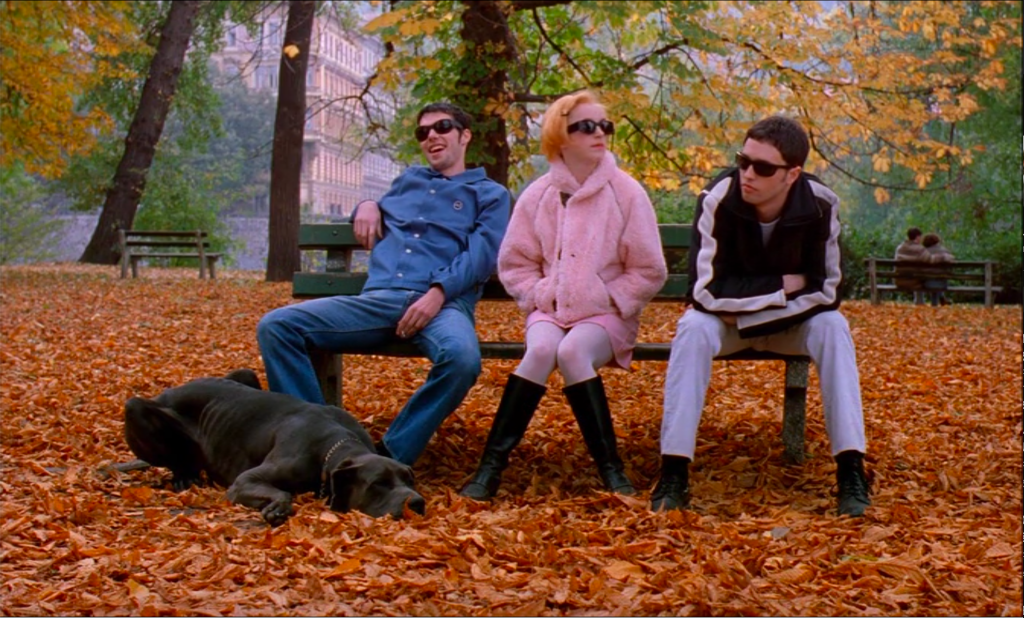
Šeptej follows Anna, a teenager who is running away from home in her village where she attends a military school. She hitchhikes to Prague with Speedy, and she seems to quickly regret getting in the car with him due to his annoying laugh and slang that she doesn’t understand. However, he introduces her to his cute and moody brother Filip, and Anna is smitten. Filip is confused and annoyed by her naïveté, but he allows her to follow him around like a puppy. But twist! Filip is in a gay relationship with one of his roommates, Kytka1. Is Filip really gay, or was he tricked into thinking he was because he’s an artist? Apparently bisexuals don’t exist in this world.
I was disappointed by the movie. The characters were irritating. I don’t think characters need to be likable, but these people were dumb, lacked depth, and didn’t seem to like each other. At first, Kytka’s presence seems progressive, but he’s clearly just there to make the movie “edgy” and be the obstacle that Anna and Filip have to overcome to find true love together.2 It was a struggle to get through it.
I kept thinking about Šeptej, though. I had really wanted to like it! The more I thought about it, I realized that if I had seen Šeptej when I was a teenager, I would have LOVED it. I was about the same age as Anna in 1996. I started thinking about the obnoxious, cringy things I did when i was 16, hanging out with people older than me, the awkward relationships and allowing people to treat you badly just because you want to fit in with the “cool” kids. People hanging out together and doing nothing but wearing fun clothes, listening to music, trying to be smarter and more talented than they are. I could see myself and my friends watching Šeptej over and over again back in the day. It is a nostalgic snapshot of that time period; I had just gotten too old to see that at first.3
Where Šeptej really shines is the music. Director David Ondříček got his start making music videos and concert films, and at one point he played keyboards in Toyen. He took the title Šeptej from a Bratrstvo song. Most of the soundtrack comes from the supergroup Colorfactory. Formed originally as an American band, British musician and recording engineer Colin Stuart took their songs with him from California to Prague and formed a band with members of Ecstasy of Saint Teresa4, Sebastians5, and Toyen6. Colorfactory’s music is sweet and soft indie pop. It reminds me of Belle & Sebastian’s7 album “Tigermilk” (which also came out in 1996) with a touch of The La’s. I’ve since found myself playing the song “It’s Always You” on repeat many times.
The film was a big success when it was released, and Ondříček has gone on to direct many more films, moving on to period dramas. As he grew as a filmmaker, he found himself disliking his early films, as people often do. However, nostalgia eventually won over and he looks at Šeptej fondly now.
Muchow was similarly embarrassed by his performance in Šeptej, as he is not an actor. However, it launched a long collaboration with Ondříček. In addition to acting and performing in Colorfactory, Muchow also scored the movie. He has since scored all of Ondříček’s films. He’s now glad that he did the movie, and that the music still means so much to people.
Colin Stuart gave an interview with Radio Prague’s Ian Willoughby where he said that there will be a 30th anniversary of Šeptej at the 2026 Karlovy Vary Film Festival, with Colorfactory giving a long-awaited reunion performance. It just so happens that I’ll be arriving in Czech Republic that same weekend of the festival, but it’s unlikely that the logistics will work out for me to see the movie or the concert. I was disappointed by the movie the first time I watched it, but now I’m disappointed that I will probably miss this opportunity to see it at KVFF! I’ll be looking out for the reviews and how people respond to it now. Will new viewers have trouble relating to it in these very different times, or will they think fondly of their own foolish youth and smile?
- “Kytka” means “flower” in Czech. Very subtle. ↩︎
- There is an essay called “Mladí a otevření: nad antihomosexuální ideologií filmu Šeptej” (“Young and Open: On the Anti-Homosexual Ideology of the film Whisper”) by Zdeněk Holý from Cinepur, Roč. 12, č. 30, 2003. I would love to find a copy of this because I assume it goes more in depth into this subject and representations of homosexuality in Czech film, but it’s not on Cinepur’s website. ↩︎
- Case in point: when I was a teenager, I watched the movie Mallrats a lot. I taped it off of cable TV for this purpose. I thought it was so funny. I watched it last year for the first time since the ‘90s, and it was terrible! I could barely get through it. What was wrong with me that I liked it so much back then?! ↩︎
- Jan P. Muchow, who plays Filip, is the only continuous member of Ecstasy of Saint Teresa. Kateřina Winterová, who plays his roommate Irma, joined EOST later and did not perform with Colorfactory. ↩︎
- From Sebastians: Jan Čechtický, who plays Speedy, plus David Volenec, Dušan Lipert, and Štěpan Tůma ↩︎
- From Toyen: Ivo Heger ↩︎
- I had to check: Sebastians formed in 1992 and Belle & Sebastian formed in 1994, so the names are a coincidence (Belle & Sebastian famously took their name from a French children’s TV show). ↩︎


Leave a Reply