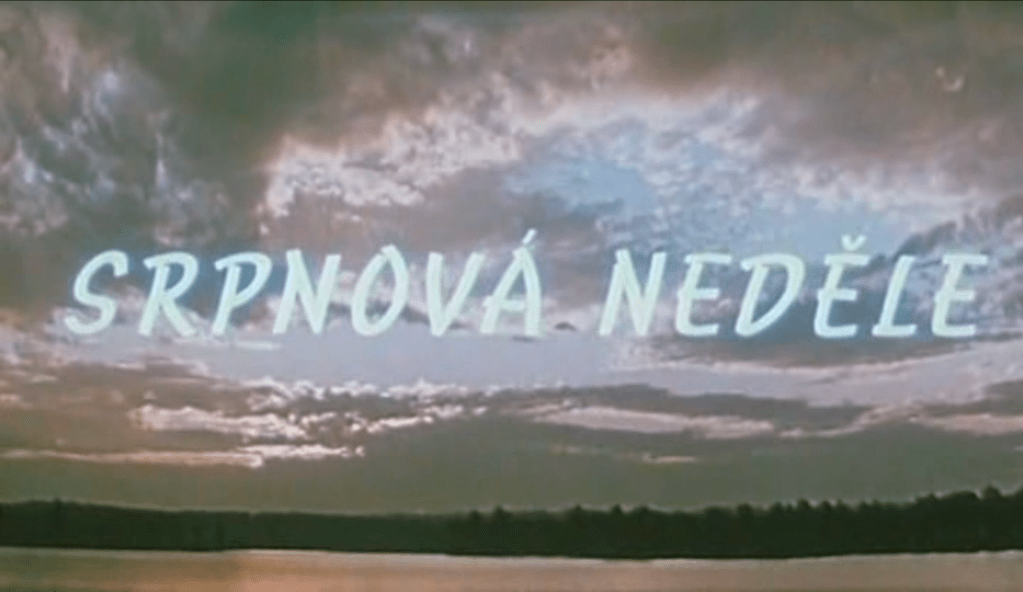
“Srpnová neděle” (August Sunday) is the first of four films written by poet František Hrubín and directed by Otakar Vávra. It was released in 1961, and it covers a weekend in a village in South Bohemia where people go on holiday. Tensions flare between the tourists and the locals, between the young and the old, and between couples. They come to a head during a dance that the postmaster and local youth have organized.
At the beginning of the film, we meet Věra Mixová, a beautiful middle-aged woman who is coming to grips with getting older. She is in town with her pretty young niece Zuzka, though she doesn’t seem happy about it. She is jealous of Zuzka’s youth. They are staying in a boarding house along with an older nosy couple, Eduard Vach and his wife Marie Vachová. Zuzka is being courted by a handsome local glassblower named Jirka. Jirka and his friends ride around the village on their motorbikes, giving rides to Zuzka and Věra. Věra is thrilled by this, but Zuzka looks concerned by her flirting with Jirka.
The conflicts begin when Věra’s husband, Ing. Václav Mixa, arrives for a visit. They lay happy in bed together, until Věra complains that she’s lonely and he’s always working. They argue, and when she says she should have married someone else, he tosses a book out the window and leaves. Their argument wakes up the Vachs and Zuzka, who confronts her aunt in the stairwell. Zuzka plans to leave early. Věra runs downstairs, but Václav has already driven off, so she picks up the scattered pages from the book and goes back to bed alone.
The next morning, the locals are preparing for an evening dance, and Věra forgets her troubles by flirting with various men, including Eduard Vach and the postmaster. Her former lover, who she introduces to people as an old schoolmate, arrives. Alfred Morák is a failed poet, and it is unclear why he has bothered to come since he obviously doesn’t want to be there. He no longer loves Věra.
The dramatics continue during the dance as the more people drink, the worse they behave. Young couples are frequently seen going into and out of the bushes. Věra flirts with Jirka but then rejects him when he tries to kiss her. Frustrated, he joins his friends and riles them up until one destroys the pretty paper lanterns that the postmaster and his young volunteers have been tirelessly hanging all day. The party is over. Drunk Morák makes a move on Zuzka, who has shown up to the party with her suitcase determined to leave as soon as possible. Věra was spying on them, and she throws herself into the pond in despair. Jirka takes his clothes off and jumps in to save her. Drenched in his underwear, he confesses his love to Zuzka, and they happily run along the pond hand in hand.
Konec.
English subtitles unfortunately don’t seem to exist for this film, so I read as much as I could about it before hand, and I tried my best to make out what people were saying. The version I watched has awful visual and sound quality, though, so that made listening to dialogue difficult. It is not considered one of Vávra’s better films, so it has not been well preserved. However, I do find that to be a shame, because despite the smudginess, it still looks to be a really beautifully shot film. Jaroslav Tuzar was the cinematographer. He also worked on Vávra’s “Žijeme v Praze,” “Cesta k barikádám,” and “Noční host.”
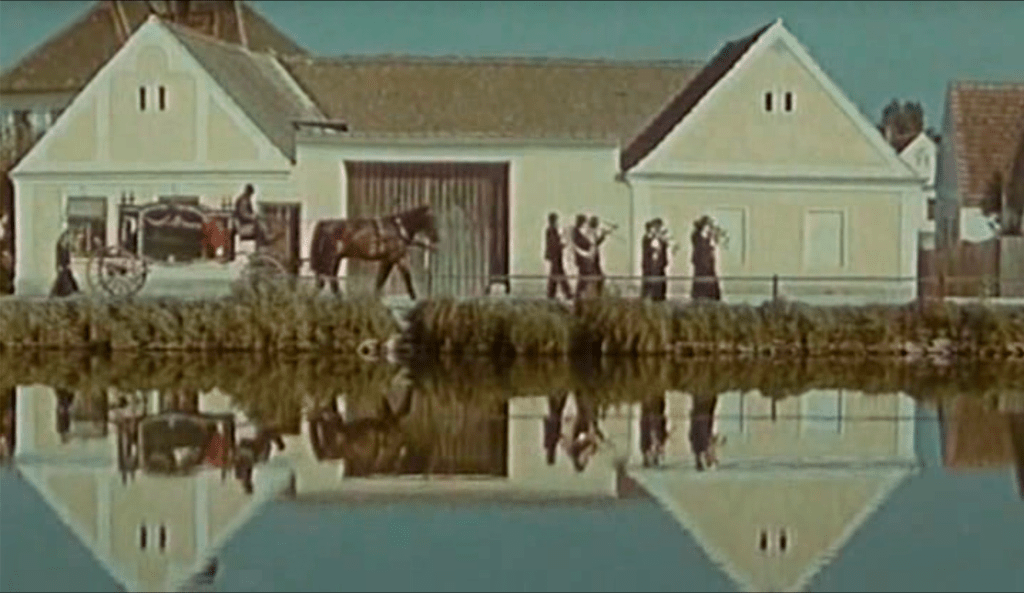
The most important character to me is the village pond, which is the centerpiece for most of the film’s activities. It is shown at all different times of the day as the sky changes color, and the sun and moon change positions. The water reflects the sky, the characters, and the buildings. There are many lovely shots of the lanterns lit and reflecting in the pond, and when the lanterns are destroyed, it is because some fall into the pond. They stay lit underwater for a few seconds before they all short out. I loved this shot of a procession of musicians walking alongside it to set up for the party.
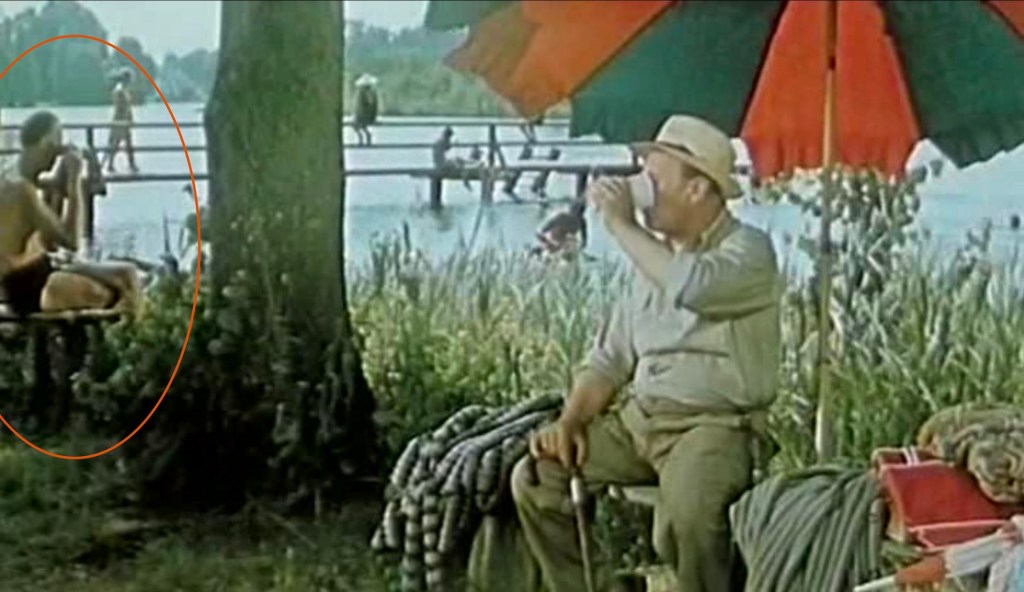
“Srpnová neděle” was based on a play written by co-screenwriter František Hrubín. The village is likely inspired by Chlum u Třeboně, where he had a cottage; it has several ponds. He enjoyed taking photographs and shooting his own home movies there. He even has a cameo in this film as a man taking photos. The movie feels almost like it could be one of his home movies, with some arguing actors thrown in. From reviews I’ve read online by people who saw both the play and the movie, it sounds like the story worked better as a play. I enjoy many slice of life village films, but in this one, Zuzka and the postmaster were the only characters I felt any sympathy for. Not that everyone has to be likeable, but no one had much depth. I didn’t mind that the party was over and everyone was going home.
- Filmový přehled page for Srpnová neděle
- Česko-Slovenska filmová databáze page for Srpnová neděle
- Pavel Taussig, “Filmovat a básnit,” Otakar Vávra: 100 Let, Millennium Publishing, 2011
 Emily Barney
Leave a comment