“Film pro všechny ženy!”1
Otakar Vávra made two films in 1937: “History of Philosophy” (Filosofská historie) and “Virginity” (Panenství). “History of Philosophy” filmed between 5/5/1937 – 7/30/1937, and premiered on 11/5/1937, while “Virginity” filmed between 10/2/1937 – 10/19/1937, and premiered on 11/4/1937. So technically “Virginity” was released first, but it was filmed second.
I originally picked “Virginity” for the project over “History of Philosophy” thinking it was Vávra’s first film, and because I was able to find English subtitles for it. After looking more into the production history of the two movies, I considered squeezing in “History of Philosophy” so I could truly say I watched his first feature film, but it would set me back in time to get a copy with Czech subtitles, and I wanted to move forward with the project. I’ll go back to it at a later time.
“Virginity” was supposed to be directed by Josef Rovenský. Multiple sources online say that he died during filming, at which point Vávra took over, rewriting the script and recasting a few parts. However, Rovenský died on 11/5/1937, the day after the film’s premiere. I’ve seen a few different stories about his death: he had some sort of nasal illness that caused deformities, and he used drugs and alcohol to cope, which exacerbated the illness2. He died of a cocaine overdose3. He had a hernia operation and pneumonia4. It’s strange that there are such wildly different accounts. Whatever happened, he must have left the production because he was ill, and then died later.
(Pozor: spoilers for “Virginity” ahead)
“Virginity” tells the story of Hana, played by Lída Baarová. It is unclear exactly how old she is, but she is probably a teenager. She lives with her mother (Jaroslava Skorkovská), alcoholic stepfather (František Kreuzmann), and two younger brothers in the back of the family grocery. Hana and her mother work in the shop all day, only for her step-father to stumble back home in the morning to take the shop earnings for his next night of drinking. Seeing Hana washing up, he is overcome with lust and he assaults her. Hana’s mother walks in as Hana is trying to push him off. Naturally, her mother is horrified at her husband’s behavior, and she kicks the disgusting bastard out. Just kidding! Her mother blames Hana, calls her a slut, and kicks her out of the house. We are in for A Good Time.
Hana goes to a waiting area full of young women looking for work. One laments how she’s been there for weeks, but there are never any jobs, and the few jobs that do get offered are terrible. In walks Josef Nevostrý (Zdeněk Štěpánek), owner of an automat (basically a café without table service). He needs a kitchen maid, who must be pretty since his customers will see her. He looks over all the women, and the agency manager points out Hana over the other girls. Ouch.
Hana starts as a dishwasher in the kitchen, but she’s clumsy and breaks a tray of glasses. Nevostrý scolds her that it will come out of her pay, and if she keeps it up, she won’t make any money. Nevostrý quickly takes a liking to her, though, and sends her to the front to bus the tables. The male customers are all immediately attracted to her, which Nevostrý notices. He also notices that the girl who is selling sweets isn’t attracting as many customers as the other sales girls, so he makes her the dishwasher and puts Hana behind the counter.
The women in the automat are all jealous of the preferential treatment of Hana. The waiter Jenda, played by a young František Filipovský, takes a protective role and gives her advice on navigating the other men’s unwanted advances, especially Commercial Councilman Rudolf Res (Jaroslav Průcha). He’s given Hana a ring. His MO is to give a sales girl a ring, then a bracelet, and then invite her to his apartment to give her a necklace.
The jealous sales girls Lili (Adina Mandlová) and Marie (Božena Šustrová) soon soften towards Hana and take her in as a roommate. One of the customers attracts Hana’s attention, a composer named Pavel Jimeš (Ladislav Boháč). Some of the customers want to take the sales girls out for a night on the town, setting up Pavel and Hana. Hana wants to see “high society ladies.” While the group teases her for this, they bring her to a bar in a cellar. No one in this bar seems to be having a good time. A pianist accompanies a disheveled woman singing “who shall give his love to me?” while an older couple swings with younger dance partners, alongside a lesbian couple dancing. A man and a woman sit at a secluded table in the back, at first seeming to negotiate sex, but the woman manages to get the man to pay her bar tab without going home with him. Hana watches all of this activity with horror, and quickly regrets making everyone come there. Pavel makes a move on her, but she thinks back to her step-father and can’t take it anymore. Pavel takes her home. He is a gentleman, and despite the misstep of a first date, Hana and Pavel go for another date boating on the Vltava River, where they fall in love. However, this is an Otakar Vávra movie, so you know Hana and Pavel will not live happily ever after!
Councilman Res, despite being warned to stay away from Hana by Nevostrý, tries to give Hana a bracelet. She politely turns him down, and Nevostrý is impressed with how she handled him.
Pavel has health issues, which would probably be manageable, except he’s a workaholic and would prefer to sleep once he’s dead. His love for Hana energizes him, pushing him to the brink. Now his friend Dr. Mikula (Bedřich Veverka) says he will die soon, unless he goes to the Tatra mountains for treatment. It is not cheap at 5,000 crowns, more than any of them can afford, especially not a sales girl at an automat. Unless that sales girl is desperate enough to visit a lecherous Councilman…
Up to this point, “Virginity” has been a fine film. Once Hana goes to Councilman Res’s apartment, though, Vávra lets his avant-garde bona fides loose. Statues of nude women greet Hana in the foyer, along with a housekeeper who directs her to Res’s apartment. As she climbs the Baroque staircase, expressionistic lighting through the ornate balusters cast shadows over her, giving the impression that Hana is a fly walking into a spiderweb.
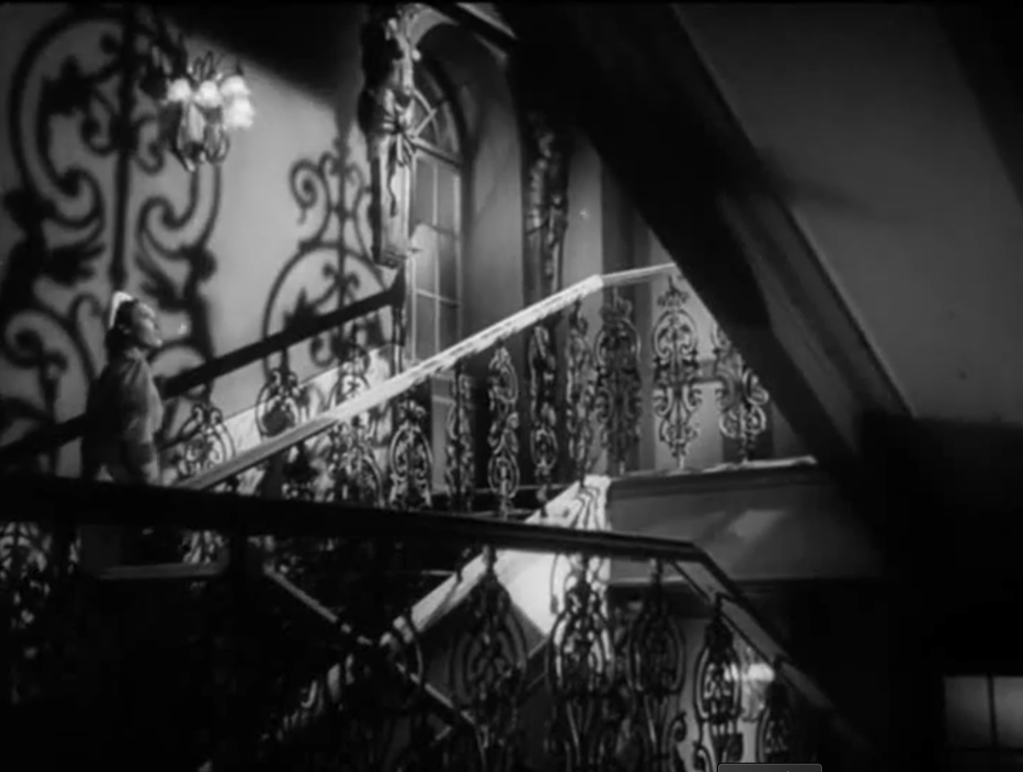
A man starts to come down the stairs. In her shame, she does not want him to see her, so she turns to leave. The housekeeper is still by the door, and thinking Hana got lost, she directs Hana back to Res’s apartment. Hana complies and goes back up the stairs, pretending to look through her purse so the man won’t see her face as he passes her.
The camera then moves down to her feet as she hesitates on the stairs. This reminded me of a scene I liked in Vávra’s short film “We Live in Prague” (Žijeme v Praze), where we witness a couple’s courtship by the movement of their feet on stairs. Hana’s feet perfectly express her fear.
Hana walks past an apartment door, where someone is watching her through the peephole. Shadowy neighbors crack their doors open to watch her. She can feel the neighbors’ eyes on her, which is rendered visually as disembodied eyes in peepholes, floating across the screen.
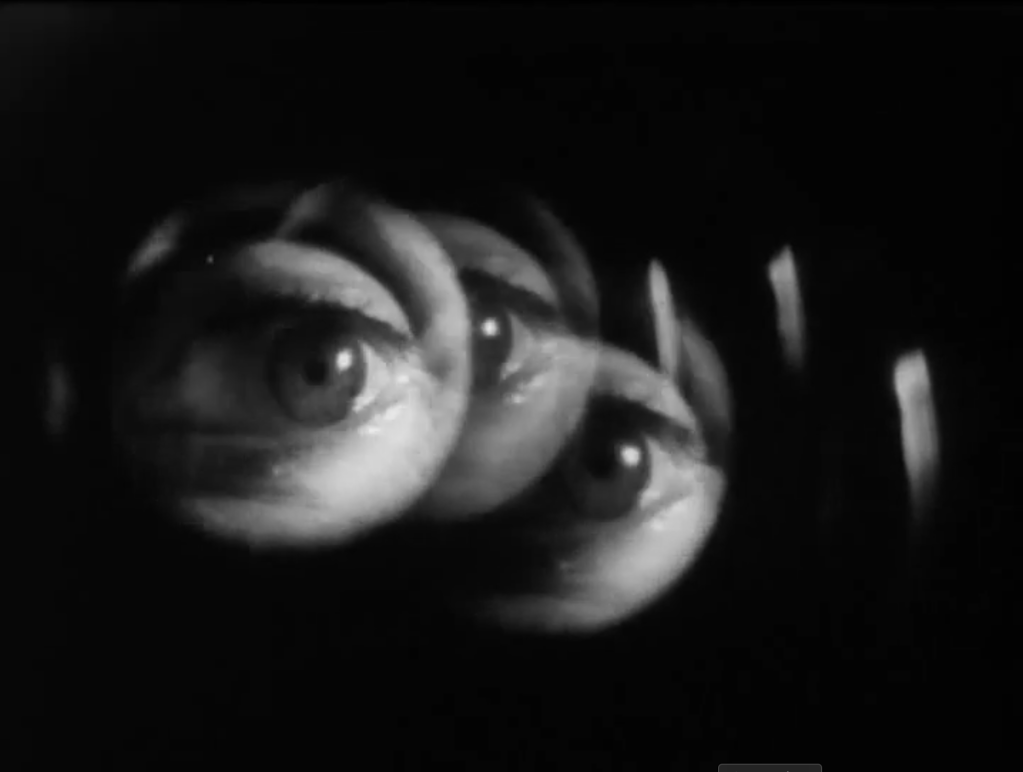
The only way she can get away from everyone’s judgement is to run up to Res’s apartment and beg to be let in. He is surprised, but pleased to see her. He shows her not only the bracelet, but a whole box of jewelry. He tells her she can have all that she wants, and then quickly makes his move. As he kisses her, Hana disassociates. She sees Pavel’s face, which appears over her own. She can’t bear to betray Pavel any longer, even if it is her only means of saving him, so she frantically pushes the Counsel away. In doing so, she knocks over a fish tank, and the fish fall to the floor, gasping for air. Also on the floor is Res, with his face in a frozen grimace. Horrified, Hana rushes to leave, but he’s locked her in the apartment. She has to go back for the keys, still in the pocket of his robe. She sees the open, full box of jewelry; she could have all she wants. Her conscience gets the better of her though, and she leaves with nothing. Pavel will die.
Hana gets one last opportunity to save Pavel. Nevostrý confesses his love to Hana. He shows her his apartment, refurbished for her and their future family. She accepts his proposal, knowing it’s the only way to get the money for Pavel’s treatment. Pavel’s friends are disgusted, but Dr. Mikula and Lili understand that she’s marrying Nevostrý out of love for Pavel. Lili consoles Hana, “very few have it as they wish…we all get used to it.” Everyone else is envious of Hana’s good fortune, and her parents even come for the wedding, boasting that they raised their daughter to be chaste. All has been forgotten now that Hana has money. Her mom has the gall to say it was a good decision to send her away. Hana makes a beautiful bride, but she looks miserable. It is again all for naught. She gets her bride price and brings it to Jimeš so he can pay for his treatment, but he’s just passed away. The fallen money dances on the floor in the breeze of the open window next to his deathbed. Lili’s words echo in Hana’s head as she leaves Pavel’s apartment in shock. “We all get used to it.”
I loved the movie. I’m a sucker for depressing social dramas (see “Tess of the d’Urbervilles,” “Jude,” and “Oil Lamps” (Petrolejové lampy). I suppose it’s like the stereotype of women being into true crime; even though these movies portray awful things happening to women, it’s also the reality of how women are treated. It is validating to see one’s own image and experience on screen. Hana is a chaste and pure woman, but that cannot save her from being a victim of the social mores of her time. I haven’t seen many movies from the 1930s, maybe a dozen or so, but it’s interesting that, despite 1937 being nearly 90 years ago, not much has changed.
In a 1937 interview with Kinorevue5, Vávra lamented the lack of humanity in Czech film, that characters were too pure and needed shadows. He wanted his actors to be true to life and sympathetic despite their faults. I think he achieved this with “Virginity.”
Actress Lída Baarová led a very different life from Hana. “Virginity” was made in the middle of her affair with Nazi Minister of Propaganda Joseph Goebbels. News of their affair broke, and Baarová’s career was ruined. Hitler directly ordered her blacklisted, though Vávra continued to cast her in his films “The Girl in Blue” (Dívka v modrém) and “Turbine” (Turbina). These were filmed after the Protectorate of Bohemia and Moravia was established, and the Czech film industry was under Nazi control. After World War II, Baarová was imprisoned in Pankrác on suspicion of collaboration with the Nazis. Her mother and sister were also under investigation; her mother died of a heart attack, and her sister committed suicide. The charges against Baarová were eventually dropped, and she was released. She left Czechoslovakia, not to return until the 1990s. Vávra remained in touch with her through the end of her life.
- The film’s tagline, “A film for all women!” ↩︎
- Česko-Slovenska Filmová Databaze biography for Josef Rovenský: https://www.csfd.cz/tvurce/3270-josef-rovensky/biografie/ ↩︎
- Wikipedia page for Josef Rovenský: https://en.wikipedia.org/wiki/Josef_Rovensk%C3%BD
Otakar Vávra 100 Let: “Ano, o Rovenském je to pravda, Rovenský na kokain dokonce umřel.” pg. 124 ↩︎ - Národní Filmový Archív inventory for Josef Rovenský: https://nfa.cz/dokumenty-ke-stazeni/badatelske-pomucky/pozustalosti/rovensky_josef.pdf ↩︎
- Otakar Vávra 100 Let, “Z článku Rozmluva s Otakarem Vávrou,” Kinorevue č. 21, 1937, pg. 33-35 ↩︎
 Emily Barney
Leave a comment